Global brands constantly balance two needs that pull in opposite directions: the speed regional marketing teams need to go to market, and the consistency global teams need across regions.
That balance often turns into tension. Global teams need reliable, comparable data across regions for insights and stakeholder reporting. Regional teams need the freedom to launch campaigns, add marketing tags and adjust tracking as campaigns evolve – often faster than a global review process allows.
This post explores the common setups for measurement and tagging, and the gains and trade-offs of each approach. Broader website governance, such as who can create pages or change security settings, usually sits with web and IT teams and deserves its own conversation.
There is no one-size-fits-all answer. A reasonable balance is possible with the right tools, but only if the setup is one the organization can actually sustain. Below we look at the decisions Google Marketing Platform offers at each layer – how GA4 is structured, how web tagging is shared, and whether to add a server-side foundation – and how to choose a mix that is feasible, not just ideal.
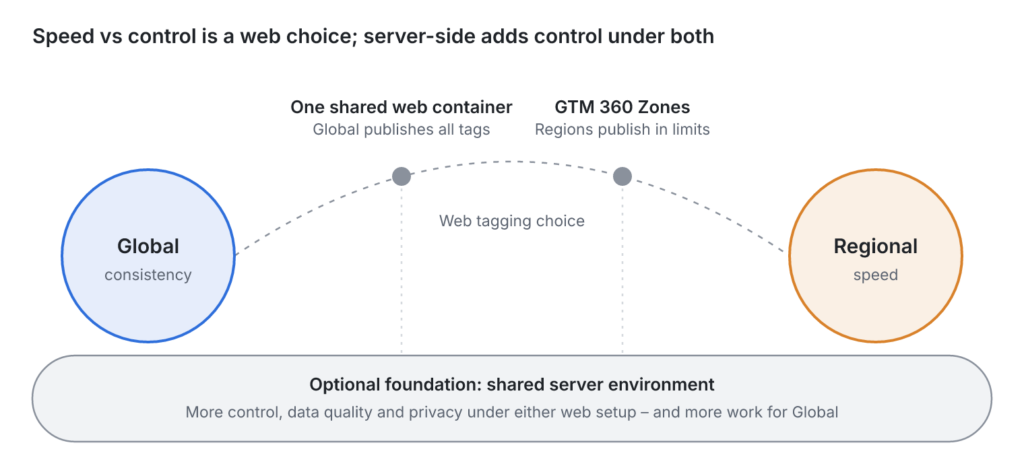
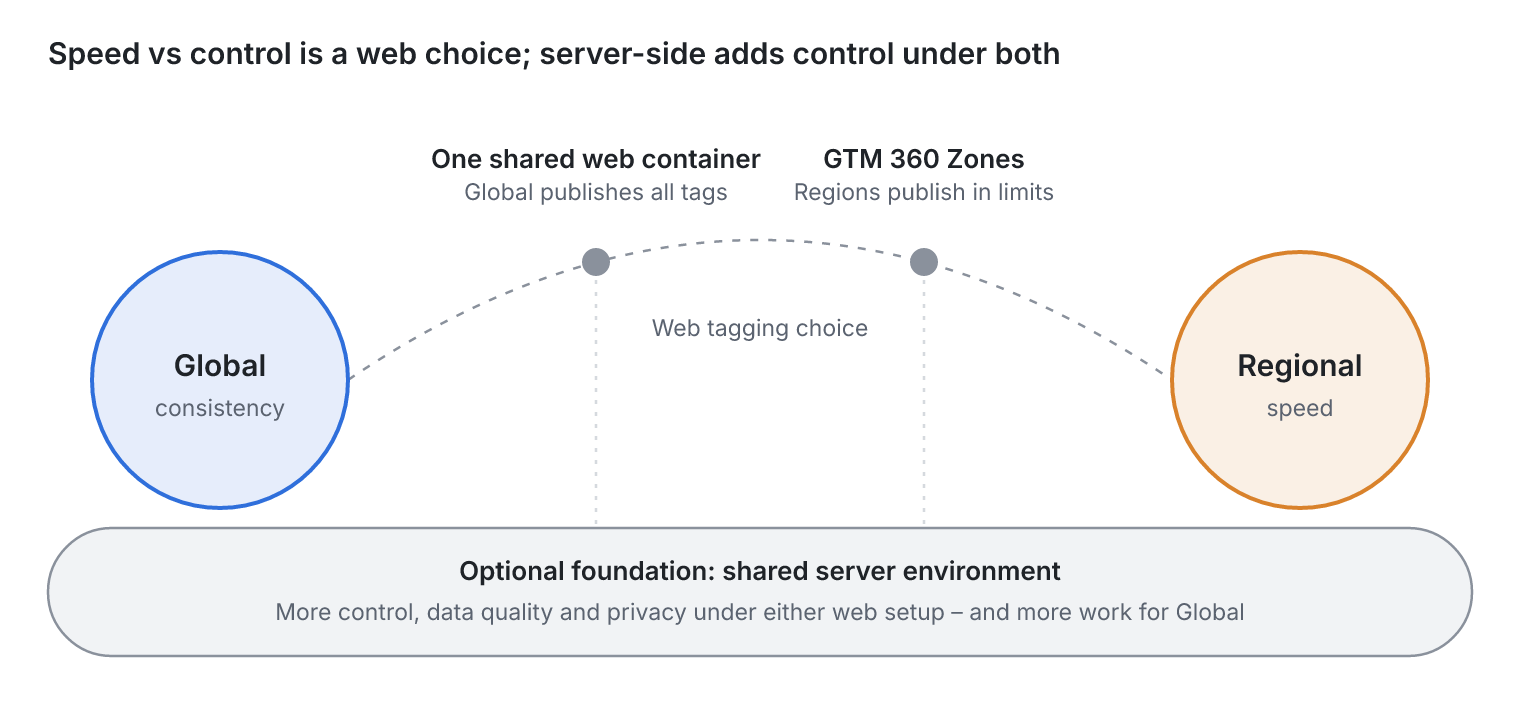
The speed vs control trade-off is decided on the web side. A server-side environment doesn’t move a brand along that line – it strengthens control and data quality under either choice, at the cost of more work for Global.
GA Structure Comes Before Tagging
Whatever the overall strategy, Google Analytics is usually the first thing to standardize. For global teams, a single source of truth for KPIs across the user journey is less a nice-to-have and more a requirement.
Comparable page views, engagement, cart performance and transactions across regions let leadership compare brand growth, website performance and global campaigns like for like. Regions benefit too: they can learn from each other with a grounded sense of what to expect.
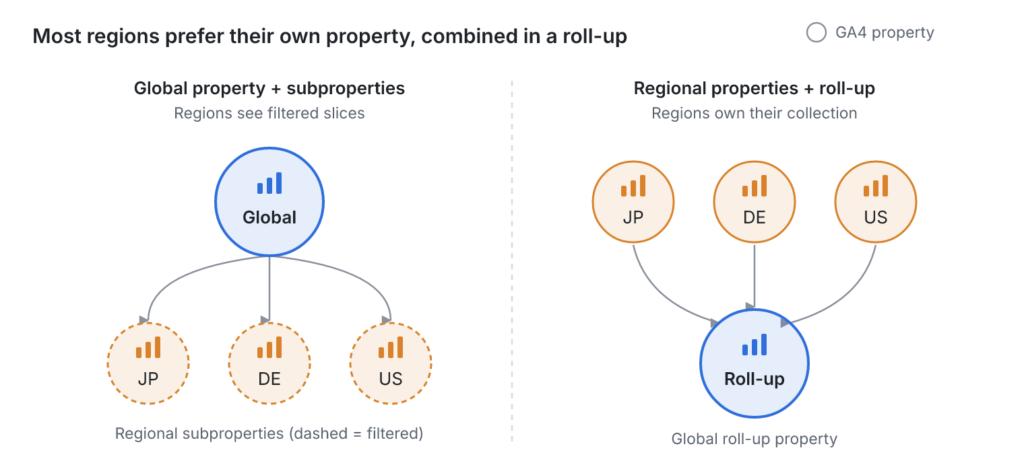
The first governance decision is how GA4 properties are organized – before any tag is deployed. Two common models:
On paper, one global property with regional subproperties gives Global the cleanest single source of truth. In practice it rarely gives regions enough flexibility. Subproperties are filtered slices of the same global data collection, so a region can’t add its own events or adapt steps – a different checkout flow, a local lead form, a market-specific campaign – without changing the global setup for everyone.
- One global property, regional views – all regions collect into one property, and regional teams get their own subproperties with their own access, without touching the global data.
- Regional properties, global roll-up – each region owns its property, and Global sees the combined picture in a roll-up property.
That is why many regions prefer their own GA4 property. They can collect what their market needs, while a roll-up property gives Global the combined view. The trade-off is consistency: a roll-up only works if every regional property follows a shared baseline of core events and naming.
Both models require GA4 360, and events in subproperties and roll-ups are billed on top of the source property’s events. Brands without 360 can get part of the way with BigQuery exports or blended reporting, with more manual effort.
Data Collection Structure
Once the GA4 structure is clear, the next decision is how data is collected on the websites. Data collection is the layer of tags, containers and shared definitions that captures what users do on a site and sends it to GA4 and the ad platforms. Who is allowed to change that layer decides how fast regions can move and how consistent the data stays.
There are three common setups, and which one is possible depends mostly on who runs the websites.
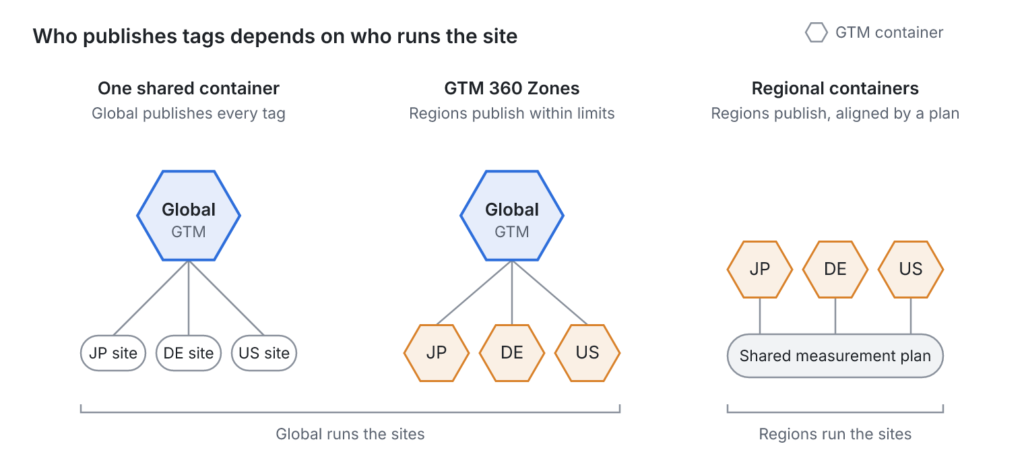
If the website is globally managed – a common setup for many brands – one shared Google Tag Manager container with a common configuration across all regions is a solid starting point. It keeps data collection consistent and gives Global clear control over who can change what. The next section looks at how Zones and regional containers give regions more room.
Regional Flexibility for Marketing Tags
A single global container can easily become a bottleneck. Marketing teams move fast: they launch campaigns, add the tags that support them, and often need to adjust that tagging while the campaign is live. Every change routed through Global slows them down.
This is where GTM Zones can help. Zones are a Tag Manager 360 feature that lets one global container load separate regional containers under rules Global defines. The global container becomes more of a governance layer, and each region gets its own container to manage.
- Boundaries – Global decides where each regional container is allowed to run, for example only on the Japanese site.
- Restrictions – Global decides what kinds of tags regions can add. Riskier custom code is off by default until Global allows it.
- Approvals – each region has its own review process, so regions can publish to their own container without access to the global one.
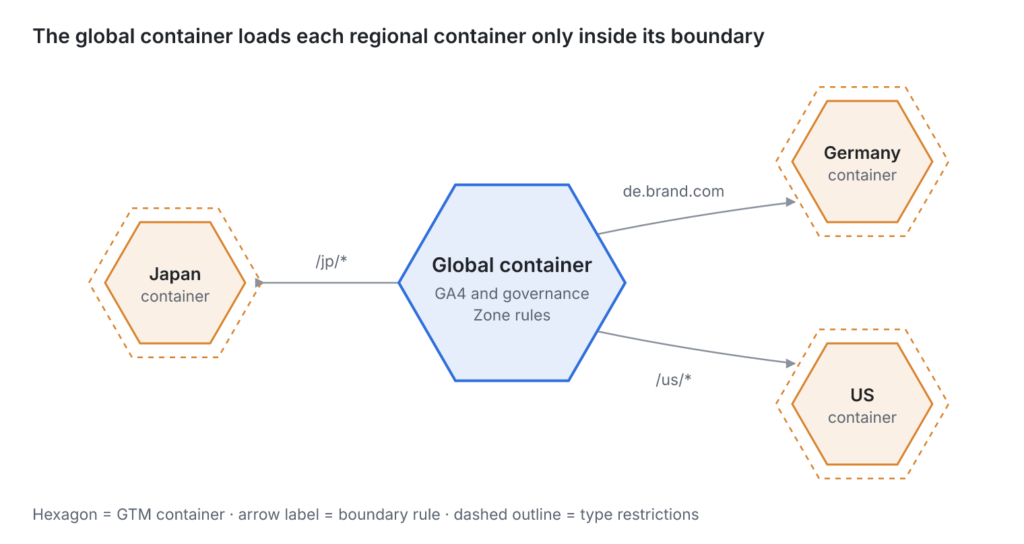
Global decides where each regional container may load and what it may run; inside those limits, regions publish on their own schedule.
Zones are not a complete safeguard on their own, and a few points need deliberate decisions:
- GA4 still needs protecting. By default, regional containers are allowed to run Google tags, including GA4. Unless Global restricts this or sets a clear rule, a region can send duplicate or inconsistent data into the global property.
- An agreed measurement plan is essential. Regional containers don’t automatically share information with the global one, so everyone needs the same definition of which events exist and what they mean.
- More containers means more to manage. Each container adds weight to the page, and consent settings have to work consistently in each one.
Zones also assume Global controls the website and can place the global container on every regional site. Where regions run their own sites, the more realistic model is regional containers built against a shared measurement plan – which doesn’t require GTM 360 at all.
Server-side – A Foundation, Not a Shortcut
Brands are increasingly aware of the advantages of server-side tagging, and the data recovery can be significant. The gains are largest in markets with a high share of iPhone and Safari users, such as Japan, where Safari’s Intelligent Tracking Prevention (ITP) shortens cookie lifetimes, so returning users look new and conversions go unattributed.
That data quality gain comes at a cost. Server-side tagging adds a layer of control on top of whichever web model a brand uses, and that layer is managed – and paid for – by Global.
One server environment can sit behind either a shared web container or Zones. Each region’s site sends data to it through its own entry point, and the server decides which platforms receive what.
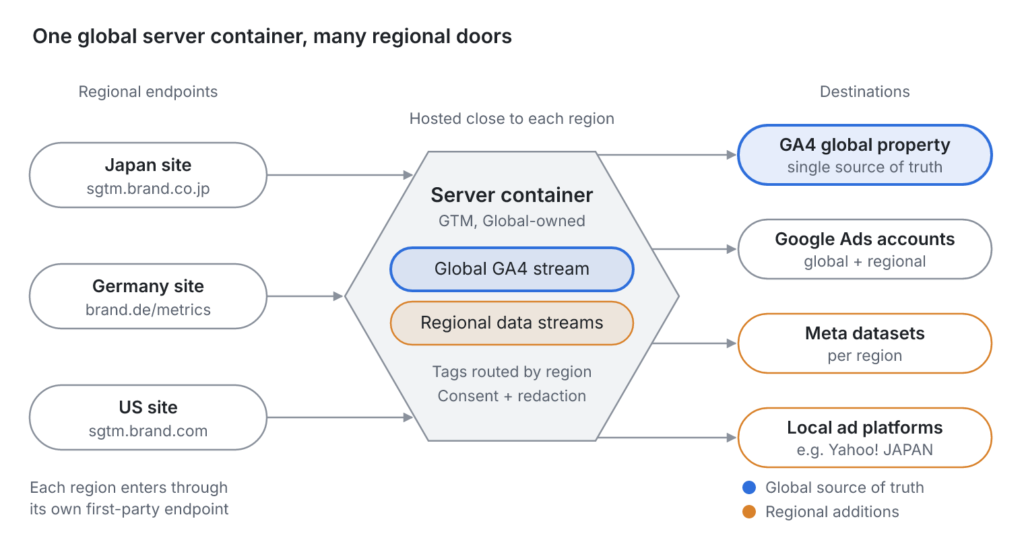
Regions enter through their own doors, but GA4 is handled once for everyone, while regional data and platforms are added alongside it.
What it adds
- Control over where data goes – Global decides what each marketing platform receives, instead of every tag sending data directly from the browser.
- Privacy enforced in one place – consent is still collected on the website, but the server can apply each region’s rules (for example GDPR or APPI) and strip sensitive data before it leaves.
- More resilient measurement – data collected through the brand’s own domain is less exposed to browser restrictions and ad blockers.
- Fewer third-party scripts – for the tags that move server-side, regional sites load less vendor code, which can simplify some security reviews. Many ad platform tags still need to run in the browser, so this is a partial benefit.
What it costs
- More work for Global, not less. Web tagging doesn’t go away – regions still need web tags to send data in. The server environment is an additional system to run, monitor and pay for.
- No regional speed by default. Unlike Zones, a server environment can’t limit what each region changes, so changes typically go through Global. Regional requests are no faster than in a shared web container.
- Specialist skills. Someone at Global, or an agency partner, needs to own it long term.
Protecting the global data
The main risk in a shared server environment is regions reusing the GA4 data stream for their own needs – adding regional fields to GA4 to feed other platforms, or adjusting shared GA4 settings to suit one market. Either change shows up in every region’s reporting.
The better practice is to keep regional data in its own stream, so global GA4 data stays untouched by design. Two caveats:
- It’s a working agreement, not a technical lock. Keeping publishing rights with Global and reviewing regional changes before they go live is what actually protects the data.
- Separate streams add some overhead. Where that matters, regional data can share the GA4 stream if Global filters out regional-only fields before they reach GA4, at the cost of one more set of rules to maintain.
Who owns what
| Area | Global | Regions |
|---|---|---|
| GA4 structure and data stream | Defines properties and what is collected | Own their subproperty or regional property |
| Ad accounts and conversion definitions | Global accounts and shared conversion standards | Regional accounts and local conversions |
| Server infrastructure and cost | Owns and runs | – |
| Regional platforms and tags | Reviews and publishes | Define needs and configure |
| Privacy and consent | Sets the baseline | Add local requirements |
Ownership of ad accounts and conversion definitions is often more sensitive than ownership of tags. Agreeing on it early prevents most of the later friction.
Choose a Mix the Organization Can Actually Run
The best governance model on paper fails if the organization can’t sustain it. The right combination depends less on what’s technically possible than on what’s feasible:
- Budget and licensing – subproperties, roll-ups and Zones require 360 licenses, and a server environment adds ongoing cloud costs.
- Skills and staffing – a server environment needs a clear long-term owner. A simpler setup that works beats an advanced one that drifts.
- Who owns the websites – this decides whether a shared container or Zones is even possible.
- Regional maturity – regions with strong in-house teams can take on more self-service, while others may prefer Global or an agency to handle tagging.
- Change process – how quickly a regional request is reviewed and published often matters more than the tool itself.
There is no single starting point. Brands that control their sites can start with a well-governed shared container and add Zones as regions need more pace. Brands with regionally run sites are better served by regional containers and a shared measurement plan, with a roll-up for the global view. A server-side foundation is worth adding to either once data quality and privacy justify the extra investment.
| Decision | Option | Fits when | What it takes |
|---|---|---|---|
| GA4 structure | Subproperties or roll-up | Regions need their own reporting and access | GA4 360 and added event costs |
| Web tagging | Shared container | Global manages the sites | A fast, clear request process |
| Web tagging | Zones | Global manages the sites, regions need their own pace | GTM 360 and an agreed measurement plan |
| Web tagging | Regional containers | Regions run their own sites | A shared measurement plan and regular audits |
| Foundation | Shared server environment | Data quality and privacy matter across regions | Cloud budget and a long-term owner at Global |
Whichever mix you choose, the tools only set the guardrails. Clear ownership, a shared measurement plan and a simple way for regions to request changes are what make the balance hold.


(グローバル)